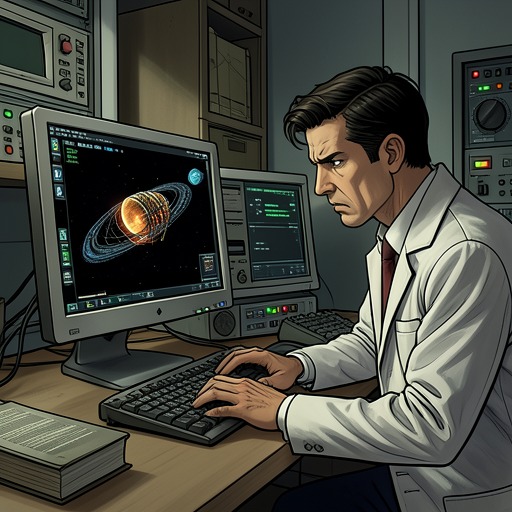
PODS anomaly-detection software failure
Deception PointPODS anomaly-detection software failure was the programming defect that rendered the satellite’s central search function ineffective—and the technical breakdown that officials disguised as a success. The distinction between what PODS could measure and what its software could recognize becomes crucial: the system’s false recovery story helped turn an operational failure into the foundation for the staged Milne Ice Shelf meteorite discovery.
Intended Function and Limits
PODS was meant to examine thousands of acres of polar ice data, rapidly flagging density departures from normal ice. Its primary target was soft spots associated with global warming, but its programming was also supposed to identify other density irregularities. The planned survey of the Arctic Circle over several weeks depended on that automated screening; without it, NASA would have had to inspect imagery by hand, a task Harper said could take decades.
The system’s broader technical limits mattered even apart from the software defect. PODS measured density from 120 miles above Earth, and Rachel noted that its computers were designed to distinguish large contrasts such as ice from slush or granite from limestone. That resolution did not necessarily let the satellite discriminate between brine ice and fresh ice. The story therefore separates a sensor’s measurements from the interpretations its software could reliably produce: a reading of an unusual density was not, by itself, proof of what lay beneath the ice.
Failure and Institutional Pressure
Chris Harper, the programmer responsible for the anomaly-detection software, described the defect as a programming flaw that made PODS essentially worthless for its intended search. He offered to repair it during the next shuttle mission by replacing the chip containing the software, but the proposed fix came too late to preserve his position. Lawrence Ekstrom sent him home on leave, and Harper understood that he had effectively been fired.
The failure landed amid an election campaign in which Sedgewick Sexton was attacking NASA. Harper said the administrator was furious, and he understood the software breakdown as a devastating blow to both the agency and the President. When the administrator later summoned him back and asked him to announce that he had found a workaround, Marjorie Tench and Ekstrom reinforced the pressure by reminding him of his responsibility for the failed project. Harper feared his career was over if he refused. He rationalized the lie as temporary, reasoning that the software would be repaired in a few months and that the claimed fix was merely being announced early.
The False Workaround and Staged Detection
Harper held a press conference announcing that he had found a workaround for the malfunctioning software. After waiting a few days, he repositioned PODS over coordinates supplied by the administrator. He then followed the chain of command, phoning the Earth Observation System director to report that the satellite had located a hard density anomaly at the Milne Ice Shelf, apparently dense enough to be a meteorite. NASA dispatched a small team to take drill cores, and the operation became highly secretive.
That account reverses the public meaning of the satellite’s apparent success. The discovery was presented as the result of a repaired system scanning the ice, but Harper’s testimony reveals that the announced workaround was false and that the satellite had been directed to coordinates already provided to him. The software failure did not independently establish the meteorite’s authenticity; instead, the claim that it had been fixed helped supply an automated-looking route to the anomaly and conceal how the discovery had been arranged.
Exposure and Consequences
The novel sets the software’s failure within a wider chain of contested measurements and interpretations. PODS first registered an unusual density object embedded beneath the ice, but the satellite’s resolution had limits. Later, when Norah Mangor insisted the glacier was solid and objected to doubts about her core data, she tested meltwater with a refractometer and found a result she could not explain. Ground Penetrating Radar offered a more discriminating method: its pulses responded differently to the crystal structures of fresh and saltwater ice, making sea ice register as a shadow. These scenes emphasize that instruments do not simply deliver certainty; their capabilities and the handling of their outputs shape what can be claimed.
The false workaround became politically dangerous once the meteorite evidence was challenged. William Pickering warned Rachel that the information she had faxed from the ship could make the White House and NASA appear complicit, even though, he insisted, Zach Herney and Ekstrom believed the meteorite was authentic. His account distinguishes their innocence of the deception from Ekstrom’s earlier role in persuading the PODS mission supervisor to lie about the software anomaly. The failure thus has two different consequences: it exposes a real weakness in NASA’s technical system and becomes the pretext for a larger institutional deception, whose political risk grows as the false account is uncovered.